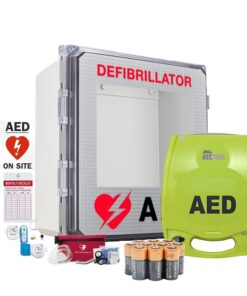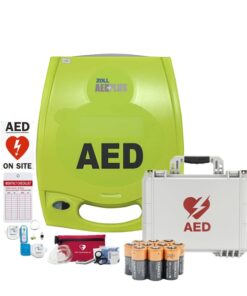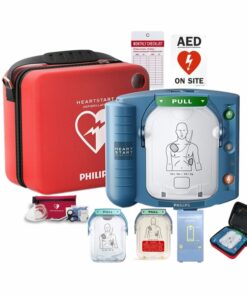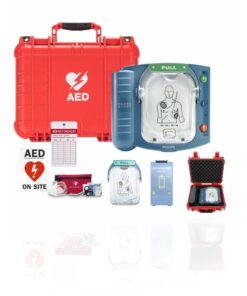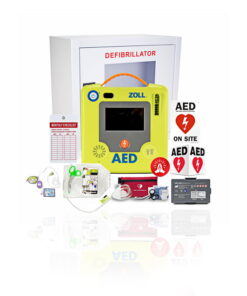
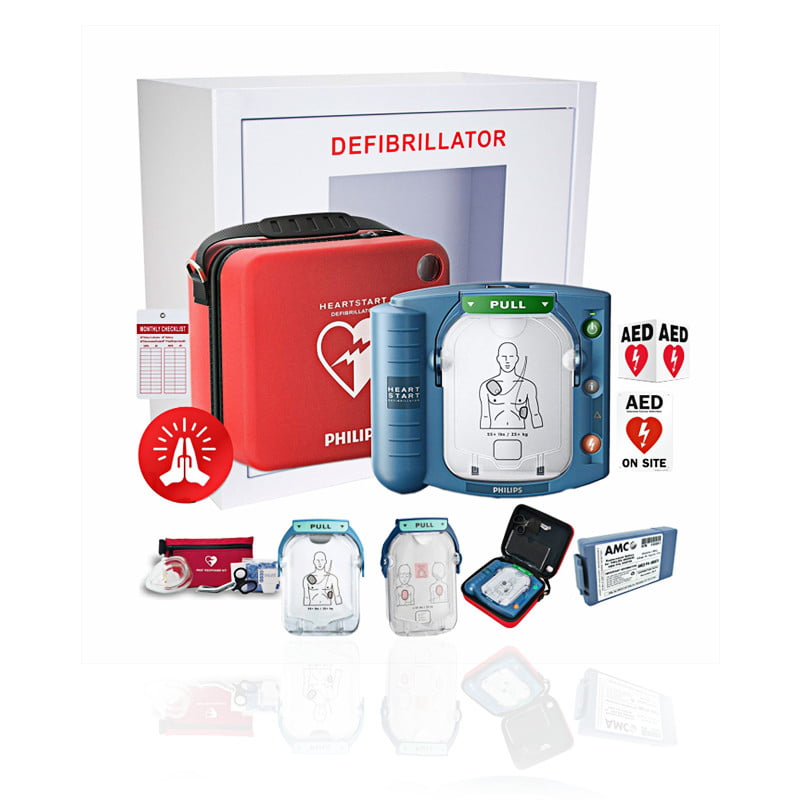


Kit Includes items typically needed in a cardiac arrest event. The nylon, zippered pouch contains (1) pair of nitrile gloves, a pocket CPR mask, scissors, razor, and (2) towelettes.This is used while using the AED and is a necessary component to complete the AED revival process.

The Philips HeartStart OnSite Adult SMART pads come in a cartridge that attach to the HeartStart OnSite AED. The cartridge can be easily snapped into the AED when replacing the pads. The Pull-handle allows the rescuer to quickly and easily tear open the pads by just pulling down on marked cartridge handle.
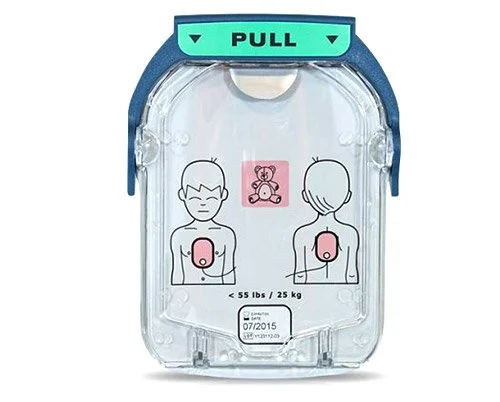
The Philips HeartStart Infant/Child SMART Pads are for use on children 8-years-old and younger or with a weight less than 55lbs (including infants). When the pads are connected to the HeartStart OnSite, the voice commands appropriately change for a pediatric rescue. Connecting the infant/child SMART pads to the HeartStart OnSite AED also reduces the joule count from 150 Joules to 50 Joules. Philips Healthcare recommends you have a spare infant/child SMART Pad cartridge stored with your HeartStart OnSite AED.

The low maintenance Philips HeartStart OnSite battery has a 5 year shelf life (outside of the AED) and 4 Year Guarantee (stand by mode inside the AED) from Philips Healthcare. This battery was specifically designed for the the Philips HeartStart OnSite, as well as the Philips HeartStart FRx AEDs. Philips recommends to always have a fully charged spare battery stored with the AED.

Transforming wall sign that can be used in three different configurations (flat, corner, triangular). Each panel measures 6 1/8″ wide by 9″ high. Total measurements at 14 7/8″ wide by 9″ high.

Put the sticker on the window of the cabinet for visible awareness of the AED. decal sticker provides information about the location of the AED, how to use it, and other important details. It is useful in emergency situations where quick access to an AED can save a life.

AED Inspection Documentation Tag. Make sure the AED is giving a green signal and this way you are in compliance of checking the AED.Check to ensure the battery and pads are up to date.

calmedequipment.com offers free UPS Ground shipping to the contiguous United States on all in-stock orders $99 and over.

Basic large defibrillator wall cabinet with window and alarm; measures 16″L x 14 5/8″H x 8 3/8″W.
An Automated External Defibrillator (AED) is necessary for churches, as well as other public places, because it can significantly increase the chances of survival for someone experiencing sudden cardiac arrest. Sudden cardiac arrest occurs when the heart suddenly stops beating effectively, leading to a lack of blood flow to the brain and other vital organs. It’s a life-threatening emergency that requires immediate intervention.
Religious places with high physical demands or high-stress levels can make someone even more susceptible to sudden cardiac arrest. California Medical equipment will ensure that your business has the resources it needs to implement a compliant and effective response program.
When considering an AED (Automated External Defibrillator) for a church, there are several factors to take into account to ensure you choose the right device for your specific needs. Here’s a step-by-step guide to help you select an appropriate AED for your church:
By carefully considering these factors and conducting thorough research, you can choose an AED that best suits the needs of your church community and helps ensure the safety and well-being of your congregants and visitors.
HeartStart OnSite AED, a popular automated external defibrillator (AED) model. It’s important to note that specific product recommendations can change over time based on advancements in technology, updates to product offerings, and new research. However, as of my last update, here are some reasons why the Philips HeartStart OnSite AED might be considered a good option for churches:
It’s important to conduct thorough research and possibly consult with medical professionals or AED specialists to determine which AED model is the best fit for your church’s specific needs. Additionally, regulations and recommendations related to AEDs may vary by location, so it’s a good idea to be informed about any local requirements for AED placement, maintenance, and training.


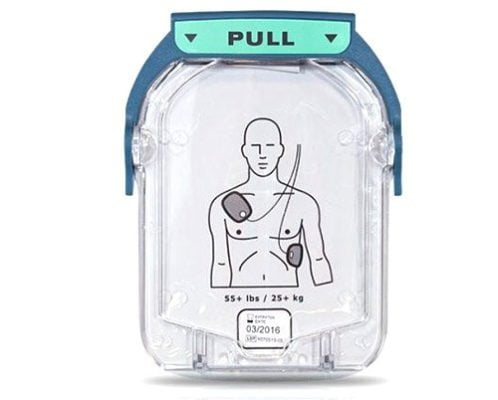
The Philips HeartStart OnSite Adult SMART pads come in a cartridge that attach to the HeartStart OnSite AED. The cartridge can be easily snapped into the AED when replacing the pads. The Pull-handle allows the rescuer to quickly and easily tear open the pads by just pulling down on marked cartridge handle.


Basic large defibrillator wall cabinet with window and alarm; measures 16″L x 14 5/8″H x 8 3/8″W.